Tuesday, May 10, 2011

Kuzushi: Where did my stance go?

This article was originally posted by me at okiblog.com. I highly recommend heading over there if you are interested in reading some great material about Okinawan Karate.

The term "Kuzushi" tends to confuse a few students at our club. I hear a few people talk about how you have to "break your opponents kuzushi before you can complete the technique.". Let's get the definition of kuzushi out of the way first, shall we?
Kuzushi - the point at which the stability of the stance is compromised, where the centre of balance is pushed to the point that requires movement in order to regain proper balance.
There are two points one should focus on in order to gain kuzushi on an opponent; the hips and the shoulders. The easiest way to disrupt these points is to crowd your opponent. Another method is to drive your opponent into the direction of least stability. I'm going to use some techniques from Juniko as examples.

Crowding

The key to gaining kuzushi when crowding your opponent is to use your stance and technique against theirs. In Juniko, the eighth technique is the perfect example of this, as shown below beginning at 0:47.


  1. Attacker stands in hidari seisan-dachi, chudan kamae.
  2. Attacker performs migi oi-zuki.
  3. Defender steps back into hidari seisan-dachi and blocks with a heishu-uke.
  4. Defender steps forward into migi seisan-dachi, wraps his (or her) left arm around the punching arm of the attacker and shoots right hand past attackers neck over their left shoulder. At this point, the attacker and defender should be hip to hip. When stepping into seisan-dachi, the defender's right thigh pushes against the right thigh of the attacker, twisting their hips and pushing their hips to their left. Depending on the height of the people involved, this could even lead to the attackers right foot leaving the ground. This is the point of kuzushi. The attackers stance has been compromised, and unless they move, they are unable to maintain stability.
  5. Defender transitions their back foot into shiko-dachi and guides the attacker over their front leg for the take-down. Since the defender has gained kuzushi, there should be no effort required to take the attacker down.
Driving

Figure 1: Seisan-Dachi
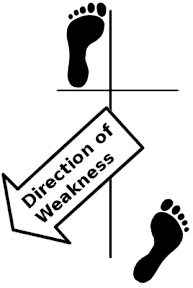
The other method of gaining kuzushi is to drive your opponent in the direction of least stability. Each stance has it's strong points and weak points, and it is of major importance that the student understands each. For instance, seisan-dachi (Figure 1) has strong stability forewards and backwards, as well as to each side. The weak point is at 45 degrees to the left or right (depending on which leg is forward) behind the opponent.

Figure 2: Shiko-Dachi

With a shiko-dachi (Figure 2), the stance is very strong along the direction of the stance, but the weak points are at the front or back of the person.

Performing the stances with the correct weight distribution, correct angle of the knees, correct alignment of the feet, should reduce the size of the weak points in the stances, but will not eliminate them.

The finer details of stances are a whole other topic. I'll cover them at some time in the near future.


Knowing this, let's take a look at Juniko technique number twelve (above video, at 1:18).
  1. Attacker stands in hidari seisan-dachi, chudan kamae.
  2. Attacker performs migi oi-zuki.
  3. Defender steps back into hidari kosa-dachi and blocks with a migi heishu-uke.
  4. Defender grabs the right wrist of the attacker with their right hand, steps forward into migi seisan-dachi and drives the attacker's wrist back behind them while applying torque to the wrist. This drives the attacker's elbow up and twists their shoulders towards the weak point in their stance. Notice the front foot of the attacker in the video. This is the point of kuzushi. The attackers stance has been compromised, and once again, unless they move, they are unable to maintain stability.
  5. Defender transitions their back foot into shiko-dachi and pushes the attacker's hand down to the floor behind the attacker's back, which is the weakest point of the stance. The attacker is pulled over the defender's front leg.
Juniko is filled with examples of gaining kuzushi on an opponent, as are most of the goshin-jitsu techniques learned in Chito-ryu. Performing these techniques correctly takes a lot of practice. Best method is to perform them slow ... a lot. After a while, the pace can be increases and eventually perform them at full speed.

Wednesday, April 20, 2011

Higashi Sensei Clinic


There are only two or three times a year that members of Chito-Ryu clubs in the Maritime Provinces get an opportunity to see Higashi Sensei and train with him, so I plan on taking advantage of every Higashi Sensei Clinic I can over the next thirteen months. I'm told that it really helps if he sees your face often, as people have a tendency to let their nerves take over during their Shodan grading, and if he sees you often enough, he is aware of what you are capable of under "normal circumstances".

These clinics also give the senior belts (kyu levels and dan levels) a better understanding about certain techniques and how we should be teaching them. One of my major complaints about KV Karate is the lack of consistency in teaching techniques. One Sensei will teach a technique one way and then another will tell you it's wrong when you're asked to demonstrate it at another class.

Frustrating.

On April 16th, several members of KV Karate (among others) attended the Higashi Clinic in Charlottetown, PEI. Typically, these clinics include a Chito Bo clinic, as well as separate time for Junior and Senior students. We arrived shortly before the junior students were completed, which gave us an opportunity to get changed and then mingle with some of the other attendees who were waiting to begin.

After a brief warm-up with Sensei Golz, Higashi Sensei had junior belts pair up with senior belts, and we went straight into gohon-kumite,sanbon-kumite, and then finally kihon-dosa-ichi and kihon-dosa-ni bunkai. It was a great opportunity to fine-tune those blocks for the junior belts as the senior belts tend to not pull their punches as much, and there was more than a few bops on the end of a nose.

After lunch, the clinic moved to the Charlottetown Chito-Ryu Karate Dojo where we continued on with Kata, bunkai and goshin-jutsu.

Seisan

There are two points in this kata that need clarification. I have been aware of these points for some time, but I run into students from time to time who are unaware of these details, and I think they should be mentioned as often as possible.  These points are:
  1. After the initial gyaku-zuki soto-nagashi-uke repetitions and turning, the next four techniques are NOT tekube-kake-uke, but rather kote-uke (wrist block) and then hiki-otoshi (pull down).
  2. After the kote-uke hiki-otoshi repetitions, the karateka must perform a soto-uke, jodan-zuki-uke (high punching block) and then shift into shiko-dachi. When shifting into shiko-dachi, pivot on the ball of your foot instead of the heal. If you pivot on the heal of your foot, you actually move slightly away from your target, and you should never move away from your target when striking, always forward.

Niseishi

I covered Niseishi before, and all of the information in that article, I'm proud to say, is accurate. Check it out.

Rohai-sho

There was only one technique discussed in Rohaisho that caught quite a few people by surprise. After everyone thought about it for a moment, it makes sense. When twisting into shiko-dachi after the migi-kyusei-kamae, you should shift in the direction of your attacker when throwing the gedan-uchi (which is actually a gedan-kentsui). Other than that, Sensei Higashi wants to see a KIAI on the mae-empi.

After going over the katas, we went over the bunkai for each, and moved into Goshin Justu (tehodoki-no-waza, tai-sabaki and ju-ni-ko). Fortunately, the partners I had for bunkai and goshin justu were senior belts (1st kyu and up) and we didn't have to spend any time teaching each other the techniques, only perfecting them.

During a couple of points during the clinic, Higashi Sensei would demonstrate the technique he wanted us to fine tune, and he would throw a punch or perform a block. It really is quite a sight to see someone 70 years old throw a punch that is the crispest and one of the fastest you've ever seen.

I really wish I had taken pictures or video.  I'll remember to take pictures at the next clinic in May at the New Maryland Karate Club, and I'll update this post.

More to come later.

Sunday, April 17, 2011

Cross Training

Now there are a lot of Martial Arts blog posts about cross training (like here and here at My Journey to Blackbelt, and here at Martial Arts And Modern Life). I'm not a fan of training multiple styles of Karate in order to round out training, but I do think that training in different fighting styles would work, like Karate and Judo, or the more obvious, Karate and Kobujitsu. There are also a lot of theories on when you should try cross training, and a lot of sources say wait until you have the basics down (shodan) before trying something different.

I started to take part in judo classes at the Fredericton Judo Club, and the work-out was much harder than what I am used to. The nights I can attend, we typically work on ground work (Jujutsu), but I think I'm going to see if I can get more traditional Judo training.

I chose Judo as a secondary Martial Art mostly due to my lack of training in dealing with an opponent who has been able to break through my defense, or has managed to tackle me to the ground (the opposite of Masami Tsuruoka, who was accomplished in Judo, and then practiced Karate to defend against a larger opponent). I'm just starting with Judo, but I am REALLY excited learning a lot of new things, and making even more friends who are dedicated to their Martial Art.